
This Week In Football is a collection of some of the best in football currently outside the walls of AFL clubs or broadcasters. Each week a curated grab bag from regular contributors and special guests will provide insight into and beyond the game on subjects of their choosing. For more about our contributors, click here.
Banner images by Polly Porridge of the True Bloods Podcast. Check out her other design work.
Changes to the board
A quick note before This Year in Football begins.
Last year we had the idea to bring together This Week in Football to collate a lot of disparate analysis. It was fun to put together – highs, lows and bits in-between.
But all good things have to come to an end. We (Sean Lawson and Cody Atkinson) are stepping away from the editorial side of the site/newsletter, and handing it off to a group who will make themselves familiar to you throughout the year. We will pop in from time to time as the season goes, but it’s time for fresh blood to pump some life into this place.
We can’t wait to see what the team does across the year.
Before the Bounce
The pre-season has culminated, the rules are being interpreted, injury lists are growing (with varying degrees of specificity and truthfulness), and if you’re thirsty for men’s football we’ve got good news for you because it’s back earlier than ever.
Provided you’re not wanting to see one of the eight teams who start their year with a bye that is.
There’s also the outside chance of a tropical storm disrupting the Queensland-based games (again).
Other than that though, we’re back in business!
This Week in Football we have:
- One Percenters Season Previews
- Lousy Smarch Football
- Football on March 5? Tell ‘em they’re dreaming
- Homegrown or Headhunted
- Around the Grounds
One Percenters Season Previews
Mateo Szlapek-Sewillo / OnePercenters
These are excerpts from the season previews I publish on One Percenters. Writing these is my favourite project each year. I try to go beyond just an expected win-loss range and look at what each club is actually trying to do with the year and how.
For the first time I’ve also compiled the full previews into an e-book. You can download it here for whatever price you deem fair, in either epub or pdf format.
Each slide below also contains a link to the full preview on my site.
[Editorial note from Emlyn: For length, I’ve sliced up the game style summaries to what I thought were the most salient points. Any shortcomings are almost certainly a case of poor editing on my part rather than Mateo’s analysis. I can’t encourage you enough to click on through to the full previews.]
Lousy Smarch Football
Jack Turner / TheBackPocketAU.com / TheBackPocketAU
Football for premiership points in the first week of March, how did we get here?
Last week it was reported on multiple media outlets that the AFL was facing a “major scheduling headache” ahead of the 2027 fixture, thanks to the Sesquicentenary (that’s a fancy word that means 150 year anniversary) Test Match against England.
Naturally this test match between two of sport’s oldest and fiercest rivals is going to be scheduled at the MCG – much like the Centenary Test was back in 1977 – as the MCG is seen as one of the two major homes of cricket, and the weather in Lords is far from reliable in early March.
But the issue is that the second weekend of March is now seen as the AFL’s window. A window that spans from the first week of March to the last week of September (or on a rare year, the first week of October). So how did this happen? And why do we feel increasingly unprepared for the football season to begin with each passing year?
The last time that Test Cricket hosted a Centenary Test between its two founding nations was in 1977. A simpler time for Australian sport, but notably the year that Australian Rules football began its invasion into summer sports territory.
In 1977 the Centenary Test began on the 12th of March – 99 years and 362 Days from the starting date of the first ever test match – and wrapped up on the 17th of March. At the time, there were still a little over two weeks between the 17th of March and the first game of VFL footy to be played at the MCG between Melbourne and South Melbourne in front of just 22,049 fans. Plenty of safe room between the summer of cricket and the football season.
But also in 1977 the AFL introduced the Night Series, what would eventually become the pre-season competition, starting a few weeks before the real season and giving clubs a chance at practice matches and fans a nice warm up to sink their teeth into.
In 1985 football crept back with the introduction of Friday Night Football, but was still traditionally beginning in the last weekend of March or first weekend of April. But now that the VFL was played across three days, it was clear that the Football Commission was becoming more flexible with their scheduling.
This became even more clear the following year when it was announced that West Coast and Brisbane would be joining the competition in 1987, closely followed by the Adelaide Crows joining the newly renamed “Australian Football League” in 1991.
This coincided with many clubs abandoning their suburban home grounds in favour of the MCG and later the purpose built Docklands Stadium, starting with Essendon in 1991 until eventually all Victorian clubs bar Geelong would play their home games at one of the two major stadiums. With anywhere between two to four games played at the MCG on any given weekend, this makes it more difficult to relocate matches if the stadium is unavailable.
While the Pre-Season Competition would continue in some format – Wizard, NAB, Ansett – from 1977 to 2013, it was never seen as the main event, and was eventually abandoned altogether due to neither fans nor teams taking it particularly seriously.
In 2016, thanks to what some might refer to as a knee jerk reaction, the AFL introduced a pre-finals bye. This one week without football in late August/Early September was the first sign we saw of the AFL season moving towards the Summer without the influence of an Olympic or Commonwealth Games.
In 2023, the AFL introduced Gather Round; a football festival to be held in South Australia with all eighteen teams playing on one weekend in the one state. To avoid fixture imbalance, this round was included as an additional neutral round, pushing the season one week earlier.
With the introduction of Gather Round, the AFL was now firmly cemented as starting its season in “Early March,” but they weren’t done yet. That same year, the NRL announced that in 2024 they would be playing the first two games of their season in Vegas, leaving a one weekend opening where League would not be played in New South Wales or Queensland – now just one week before the AFL happened to schedule its first round.
So now here we are in 2026 – much like we found ourselves in 2024 and 2025 – with five (previously four) games of football in the first weekend in March. This time for the first time with the last of those games to be played at the MCG. A stadium named and known world wide for a totally different sport to the one that now dominates it locally.
So we do find ourselves in a conundrum of sorts, but one of the AFL’s – and the MCG’s – own making. Were the Centenary Test held this year and starting on the second Friday in March the AFL would have to reschedule a minimum of four games. Likely another two if the centre square wasn’t up to scratch by round two.
It is of course very likely that the MCG would be back in perfect condition by the last weekend of March, just in time for the once traditional start date of the V/AFL season.
Football on March 5? Tell ‘em they’re dreaming
Lincoln Tracy | lincolntracy.substack.com
If you feel like it’s too early for “real” football to be back, then you’re not wrong.
As Swamp posted on X over the weekend, 2026 is the first season in V/AFL history where matches will be played on March 5 and 6, making tonight’s game between Sydney and Carlton the earliest day of the year that teams have played for premiership points.
The previous earliest day was March 7 in 2024 and 2025, when the Swans played Melbourne and Hawthorn, respectively. The old record would have been March 6, had Cyclone Alfred not forced last year’s match between the Brisbane Lions and Geelong to be postponed to Round 23.Provided there are no unforeseen interruptions for the Swans/Blues and Gold Coast/Geelong games over the next two days (note: I wrote this before I saw reports of another topical cyclone heading towards Brisbane and the Gold Coast), we can now say that 228 different days of the year – ranging from March 5 to October 24 – have seen at least one game of football over the years. April 25 has seen more games of football than any other day on the calendar (141, which will jump to 145 after the four Round 7 games next month).
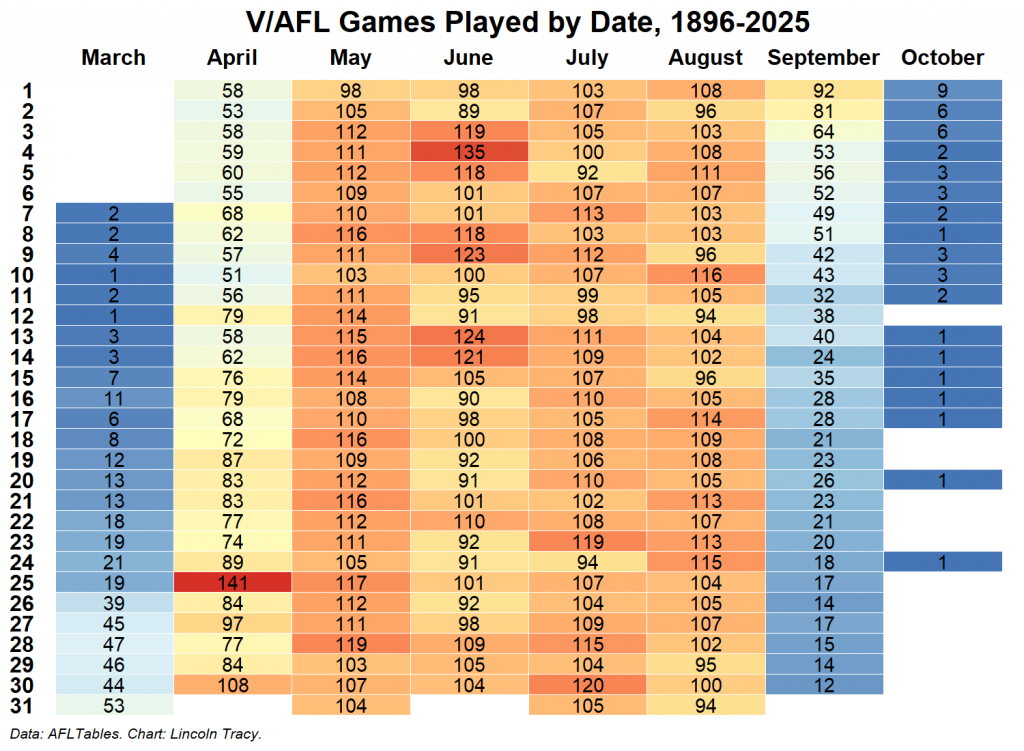
We can see from the figure above that May through to August have hosted the majority of V/AFL matches over the life of the league. The season started in late April or early May from 1896 through to the 1950s. But clearly not satisfied with this four-month window, the start of the season started creeping earlier and earlier in the year shortly after that.
The first taste of March football occurred in 1979, when the VFL played the Round 3 game between Carlton and Essendon on March 31, a week before the rest of the season started. Rohan Connolly has previously reported that there was no real reason as to why the VFL – in their (in)finite wisdom – decided to go ahead with this.
But the people who run the game have never needed anything resembling common sense or logic to justify their actions (see executive general manager of football performance Greg Swann’s comments on AFL360 about the consequences of the new ruck rule for an example of this). So, we push on.
All but two seasons since the strange decision of 1979 have started in March, once again getting progressively earlier into the season, to the point where competitive games now occur in the first week of March.
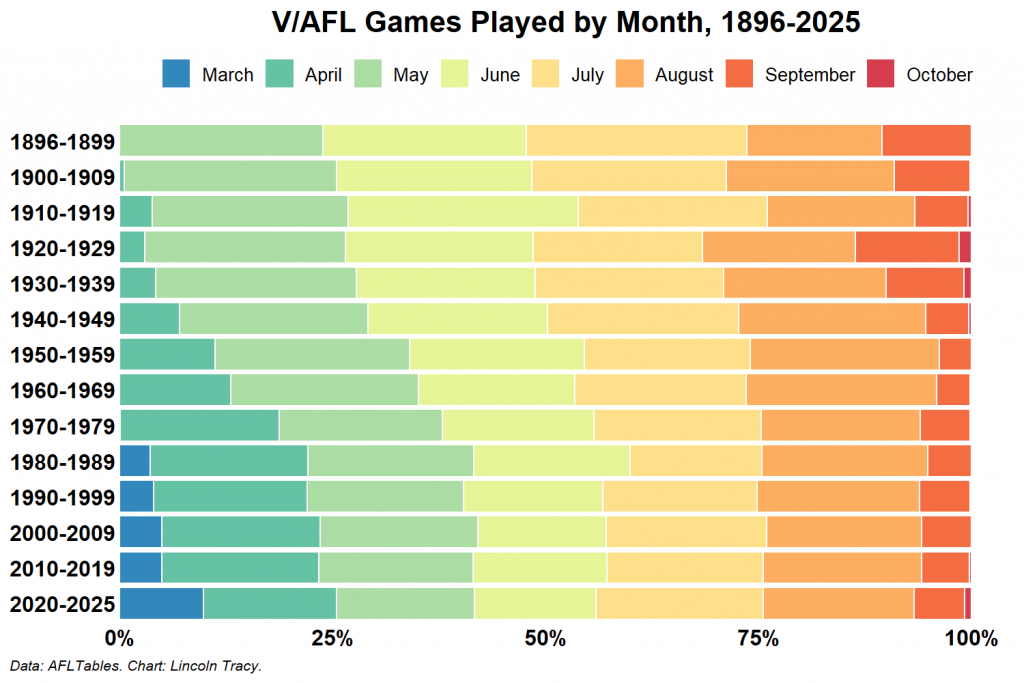
Games in March accounted for 4-5% of all games each decade between 1990 and 2019. That figure has essentially doubled from 2020 onwards, sitting a shade under 10% for the current decade (excluding 2026 matches). The last five years have seen 18, 19, 20, 28, and 27 matches played in the third month of the year. There are another 28 slated for March this year (cyclones permitting).
There has been a growing chorus of voices over the past decade – fans, players, coaches, and the media – protesting that the season is too long.
And it’s hard to disagree with that sentiment when you think back to 2025, where Opening Round, Gather Round, staggered byes, and a divergence in competitiveness between the top and bottom teams all combined to give us (what felt like) a never-ending season.
I can’t see 2026 being any better, given we had the State of Origin game last month and have the wildcard matches (which simultaneously are and aren’t finals, depending on how the boys and girls at AFL HQ are feeling).
Don’t get me wrong – I love footy and everything that comes with it. But we all need a little break from time to time. And at the rate things are going, perhaps we’ll be playing for premiership points in February before I shuffle off this earth.
Homegrown or Headhunted
For the start of the season I’ve prepared some charts on how each club’s list has been assembled. For the main split I’ve simply gone with whether a player was on an AFL list prior to arriving at their current club.
There’s a surprising number of ways players come into the AFL system, and I’ve compiled this across three different sources trying to match as best I can. It’s possible a couple of errors have slipped through, if you spot one let me know about it.
The faded bars indicate where a player had not yet debuted for the club. The years labelled indicate the player’s first season on the list. So someone drafted at the end of 2024 would show as 2025, as would someone who joined in the 2025 mid-season draft.
A couple of things jump out to me:
- GWS and Carlton sit at polar opposites. GWS has just five headhunted players compared to Carlton’s 19.
- Richmond only have 6, but that makes more sense for where they’re at in the cycle. They’ve clearly set out to get a critical mass of young talent to develop together.
- Collingwood’s homegrown recruits from 2023 onwards have just 58 games between them. The next lowest are Port Adelaide (75) and Fremantle (78).
- West Coast are way in front with 353 games already from those three draft classes (and another 7 new players coming in this year, as well as 5 more arrivals previously on a list elsewhere). St Kilda, North, and Brisbane all break 250.
Around the Grounds
- How Dockers players are supporting draftee through Ramadan
- FIFO workers keep football leagues alive in Pilbara towns with transient populations
- [content warning for sexual assault] The town that turned its back on a rape victim
- Comettiisms
- Ladder Predictor using win % rather than absolute win/loss predictions
Leave a Reply