
This Week In Football is a collection of some of the best in football currently outside the walls of AFL clubs or broadcasters. Each week a curated grab bag from regular contributors and special guests will provide insight into and beyond the game on subjects of their choosing. For more about our contributors, click here.
Banner images by Polly Porridge of the True Bloods Podcast. Check out her other design work.
Before the Bounce
Big weekend of footy for xScore enjoyers.
Geelong proved you can win on sheer volume of looks at the goal, GWS showed everyone regresses to the mean eventually, and Fremantle showed bad kicking can still be 10-goal winning footy.
There’s also a new era of cellar dwellers.
After spending most of the decade battling each other for the right to first pick, North Melbourne and West Coast won in the same weekend for what feels like the entire history of the league.
Not to be outdone though, Carlton set up the laziest content creator you can think of with a slam dunk April Fool’s post.
This week in football we have:
- Joe Cordy Is a Bad Ruck Better Than No Ruck?
- Emlyn Breese: Age isn’t a number (Its a scatter plot)
- Seb Morrison: Competitive Advantage
- Jack Turner: The AFL Needs a Better Clash Policy
Is a Bad Ruck Better Than No Ruck?
In November last year Fremantle went riffling through other clubs’ discarded players, and fished out the last remaining and arguably only successful product of a long forgotten push to open a new frontier in international recruitment: the 211cm 34-year-old former Division I NCAA basketballer and OSU alumni Mason Cox.
Despite putting up his most lacklustre season since recruitment, battling injury and being right near the typical expiry date for professional athletes, Fremantle saw enough in him to offer Cox a 2-year deal.
The reason for it is pretty simple: Cox is one of the few players in the incredibly slim venn diagram of those willing to accept a contract knowing they’ll never be called on without an injury or suspension to a player higher up the depth chart, and who has proven he can actually fulfill the role of a ruck at AFL level to any capacity.
With Luke Jackson and Sean Darcy at the core of their current build towards an inaugural flag, the footy department felt they needed to avoid the exact situation their Round 3 opponents found themselves in: a selection panel so bereft of ruck options you’re forced to play two 195cm players in the role. But how did Richmond find themselves in this position, and how big an advantage was it for Fremantle?
great gear to have a game where we really needed our ruck to silence the critics and have a bit of a confidence booster, and our opponents just didn’t play a ruck
– Fremantle fan and Frenemy of the Newsletter Mimi Birch
Height Distribution in League
I’ve never once bought into the idea of there being not enough talent to distribute across the league, an argument we’re now seeing again with the looming spectre of Tasmania and the high likelihood of a 20th team. The one exception to this might be in finding genuinely good rucks, or even just athletes tall enough to fit the bill.
Let’s say you’re searching for a new ruck from outside the league or the national draft to bring onto your list. Australia in 2026 has an estimated population of approximately 27,000,000 people; of that, just over a fifth are in the typical professional athlete age range of 20-34, and just under half of them are male. If you then screen for just those men who are at least as tall as the shortest established AFL ruck currently in the league (198cm), you’re putting a line through 99.98% of potential candidates. Some development and investment into them as a player is to be expected, but you’d ideally like them to be currently playing footy in any capacity, which the ABS estimates is just 1 in every 50 men.
After filtering for just those that meet the minimum height requirement, are in the right age range, and have at least basic understanding of the game, you’re left with a pool of approximately 1200 potential recruits in the country, or 0.004% of the population. Despite this, every club in the league finds space for at least two rucks on their list, even if there’s never space for more than a pair of best-23 capable players.
It’s for this reason that rucks are especially sticky on lists. They typically take years to make it from being handed a jumper on Draft Night to one on debut, and are virtually the only players list managers don’t cut after 30 when you’re not getting regular time in the seniors.
The Efficacy of the Ruck Tap
The hit out numbers were, as you might expect, a completely one-sided affair. If Richmonds Campbell Grey and Mikelti Lafau had managed to combine to win as many as they have thus far in their career, they’d still be behind what Darcy and Jackson won individually on the day.
Even though they were soundly beaten around the ground and in the ruck contests, the other metrics we typically use to measure stoppage attack didn’t reflect the same uncompetitiveness.
In 2022 Cody Atkinson and Sean Lawson, friends of mine and yours, published an article in the ABC focusing on Port Adelaide’s ruckless setup with Jeremy Finlayson taking the hit outs. They showed that through the previous five seasons there had been little correlation between hit out margins and the score, but a rather large one when it came to clearances. Updated for 2023-2025 numbers and the numbers look extremely similar.
Hit outs have strong diminishing returns…
…while dominating clearance has significant positive returns.
The issue is how few hit outs won go directly to the advantage of a teammate. In 2025 the AFL average was 10.4 from 97.8 ruck contests a game. Even Fremantle’s twin towers were only able to combine for 12 per game.
Teams, even bad teams like Richmond currently are, are simply too sophisticated to let anyone create them in high volume. Most rucks at AFL-level can at least put enough pressure on their opponent to stop them putting it perfectly into the hit zone, or if they can’t their teammates learn to read it off the opposition’s hands.
If you’re familiar with Betteridge’s Law of Headlines, you were probably immediately aware the answer was “No.” Rucks are still valuable, good rucks especially, but ironically it’s for everything outside of the ruck contests. You need them to be able to provide a presence post-clearance, whether it be aerially like Gawn or at ground-level like Grundy; there’s no point to having some lumbering running around the ground if he’s not providing any follow up. If you’re fresh out of the non-lumbering kind, a pair like Gray and Lefau are as good a solution as any.
Age isn’t a number (it’s a scatter plot)
(Credit to Sean for the title)
There’s a lot of ways to measure how old a club’s playing group is. This week I came across one of the more unique methods – just removing the three oldest players (each important contributors) from one club and comparing it to the raw figures for the other clubs.
Yes, it turns out that if you exclude the oldest players from one teams list and include the oldest players in every other team’s lists your rankings will change. If you apply the same logic across the league however Collingwood is still the oldest.
Now three is an arbitrary number but even so it produces some interesting results, just not with Collingwood. By excluding the top three players in every list’s mean age Geelong go from ranked 2nd oldest to 10th! That’s a massive change and shows that underneath Dangerfield, Stanley, and Blicavs they’re around the competition average. In the other direction Gold Coast have an even bigger change going from 4th youngest to 3rd oldest, despite taking 6 players in last year’s National Draft. In between Witts, Collins, and Holman at the top and their academy crop at the bottom they’ve got a mass of prime age players at their disposal.
One criticism of looking at mean (what people are most commonly talking about when they say average) is it’s susceptible to outliers. We can also look at lists by median – if you line the players up by age, how old would the player in the middle be. If a team has a pretty even distribution the mean and median will be similar. If a team has a handful of super-veterans you’d expect the median age to come in lower, while if they’ve got literal babies crawling around on the park the median will bring it up.
There’s a lot more variation in how old you can be in the AFL than how young (minimum draft ages), so by using median we’re usually controlling for the impact of a group of particularly old players and we’d expect the movements to be similar to excluding the top three. The big exception here is Essendon, by mean they’ve got the 3rd youngest list, by median they’ve got the 6th oldest which leads us to a quick diversion.
Checking out the distribution of ages we can see a gaping hole around their 22 year olds, between Archer May (21.35 years old at the start of the year) and Liam McMahon (23.67 years old).
If we look at Essendon’s list build chart (each team covered in Round 0’s edition of TWIF) we can see why. Nic Martin (Supplementary selection period), Elijah Tsatas (Pick 5) and Lewis Hayes (Pick 25) are the only players still on Essendon’s list from the 2021 and 2022 draft periods.
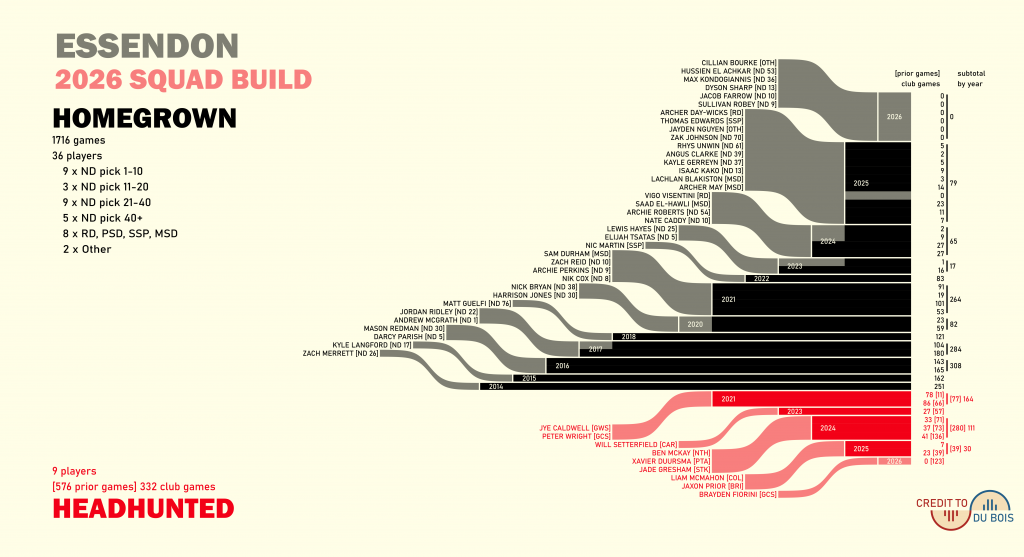
Ben Hobbs (Pick 13), Alastair Lord (46), Garret McDonagh (50), Alwyn and Jayden Davey (Picks 45 and 54), Tex Wanganeen (SSP), Jye Menzie and Jaiden Hunter (Mid-Season draft), Anthony Munkara (Zone selection), and Rhett Montgomerie (Rookie Draft) are all gone from the AFL now.
Patrick Voss (Rookie draft) was delisted and subsequently recruited by Fremantle, while Massimo D’Ambrosio (Mid-season Draft) was traded to Hawthorn.
Their other list additions from those two years are Jake Kelly (Free agent), Will Setterfield and Sam Weideman (Trades). Only Setterfield is still in the AFL, although after being delisted and picked back up through the SSP.
Aside from Ben Hobbs none of the players gone cost a lot to bring in individually. You can’t guarantee a star or even a solid role player from those picks. When you’re throwing that many darts though you need at least a few to hit, otherwise you end up with holes in your list.
The next way we could look at ages is based on selected sides. Having a few 30+ year olds on your list that act as useful depth and provide leadership off-field (Tom McDonald) is very different to your game revolving around them (Max Gawn).
Using mean the big mover is Gold Coast – expected as they’ve got a mass of young players dragging down the list average, while the sides they are picking week to week are relatively mature.
If we move to median Hawthorn jumps out, going from the fourth youngest median list to the 2nd oldest median selected team. Essendon and Melbourne move down quite a bit by this measure too, as do Fremantle fielding the second youngest sides.
Finally looking at how things stack up historically, I’ve taken a look at ages of selected teams across the first 3 games of a season.
It’s unsurprising that Collingwood’s median age across the first three games is the oldest it has ever fielded. Another nine teams have been in the 80th percentile or above for oldest teams they’ve fielded, with Carlton the oldest they’ve been since 1944.
League-wide it’s the 7th oldest and a trend emerges with 2023, 2024, and 2025 coming in between 8th and 11th oldest. We haven’t had a particularly young season since the introduction of Gold Coast and GWS in 2011 and 2012.
And inspired by Max Gawn’s milestone game on the weekend I thought it would be interesting to take a look at how the rate of players achieving milestones has changed over the years.
An important note, this last chart excludes players who never played a career game. I don’t believe there’s a convenient long-term listing of team lists year by year, so I’ve used the game stats from AFL Tables to capture anyone with at least one career game.
Opening Round Competitive Advantage
There should be no competitive advantage in teams having played a game before they play another team [that hasn’t]
Justin Longmuir following his team’s Round 1 loss to Geelong
It’s been a fortnight since the entirety of the football world espoused their views on Justin Longmuir’s Opening Round comments, ranging from affirmation to condescension to whatever it was that Caro went with. Through all the noise and hyperbole, there seemed to be lacking anyone able to assert in empirical terms whether JL was accurate. Fortunately, we live in a world of clever people and big data sets. Unfortunately, those clever people have better things to deal with, so here I am to have a go instead.
The validity of Longmuir’s position is of tepid interest to most people, including myself, however it does provide a nice segue into a more general discussion regarding the extant ‘Competitive Advantages’ in the AFL. This is a meatier, far more interesting conversation, and one that I’ll look to expound on throughout the season in TWIF and elsewhere. For now, let’s peruse the supposed advantages enjoyed by participants of the now maligned Opening Round.
The general assertion made by Longmuir alludes to the disparity in athletic capacity experienced by teams in their first game of a season and their second. Throughout the media, most ex-players seemed to concur that the first game of the season is more challenging on an aerobic level, before berating Longmuir for saying so.
GPS data going from 2017 is summarised below to show the following increase in athletic output from a team’s first game to their second. I’ve highlighted four measures of athletic output; total distance ran, high speed distance, total sprints and repeat sprints.
Teams do not seem to cover any additional distance in their second game of the season as compared to their first, but the explosive work does experience an uptick. On a ten-year data set, a marginal but persistent increase in high-speed distances of 5.3%, sprints by 4.5% and repeat sprints by 5.7% are evident.
Round one of 2026 saw six opportunities for this statistic evidence to play out. Six Opening Round participants played their second game against a side supposedly still blowing off high-speed cobwebs. Dropping total distance, the results on our three remaining measures are below.
Sprints
High Speed Distance
Repeat Sprints
In round one, every team playing game two more distance at high speed than their season-opening opponent. Total sprints exhibit a similar disparity, with the average brought down by a woefully unathletic Carlton. Interestingly, repeat sprints seem to exhibit no real correlation for the 2026 games.
Fourth quarter data provides a similar overall picture, with teams in their second run outperforming opponents across all athletic categories. The difference certainly doesn’t inspire a royal commission and again, Carlton provide a distinct athletic outlier. Shown below, teams seem far more capable of repeat sprints in fourth quarters in their second game. The other measures show slight overall upticks from game one to two.
Sprints
High Speed Distance
Repeat Sprints
Although marginal, GPS data does support Justin Longmuir’s claim to a competitive advantage in round one games where an Opening Round participant opposes a non-participant. The advantage enjoyed by the beneficiary has not shown itself to be definitive in 2026, with results falling in favour of Adelaide and Melbourne, however in both of those games the team with the supposed athletic advantage were ascendant in the final quarter.
The benefit at hand for Opening Round participants is not wholly captured by athletic data. Although harder to quantify, decision making and skill execution is clearly done under more duress by teams in their first few games compared to later in the year.
As if they were intentionally doing so, the AFL have managed to elaborate on the advantages gifted to Opening Round participants by instituting a subsequent early round bye. The deformity made to the schedule with the inclusion of “Round 0” has managed to bleed as far into the fixture as round four, with GWS and St Kilda’s enjoying a week off. The rest is significant, almost all Opening Round participants are nursing significant injuries, with GWS the most afflicted of any team in the competition. How would Adelaide enjoy a week off now, reducing the games of actual football they would have to endure without some key personnel. Instead, injuries to the likes of Petracca, McCluggage, Taylor and Heeney will impact their respective teams less than injuries at the same stage of the season to Dawson, Young and others.
In short, participation in the Opening Round is a narrow but real advantage to those teams over the rest of the competition. With the expansion to include two standalone Victorian teams, the AFL has undermined their ability to justify such an arbitrary distribution of competitive advantage. With the best teams from the season prior selected to play Washington Wizards to the northern states Harlem Globetrotters, the stratification of the league is institutionally endorsed by the AFL in order to satisfy strategic goals that are no longer entirely clear.
The AFL Needs a Better Clash Policy
On Saturday Morning, the Brisbane Lions ran out onto the turf of Docklands Stadium wearing a crisp and aesthetically pleasing retro jumper – a redesign of the Fitzroy kit worn by club legend Kevin Murray through the majority of his 333 game career. A beautiful deep maroon and navy blue with white monogram, in a style the club hasn’t worn as their retro kit for nearly a decade. The only problem is they chose to wear this much darker and redder kit against St Kilda, a team who wear predominantly black jumpers with red and white.
Former captain Dayne Zorko even spoke to 3AW after the game about the obvious confusion it was creating for players and fans alike: “We will start with the jumper clash. I don’t know how they approved that? Early on everyone was coming off saying, “We just don’t know who to kick it to?” Thankfully we had the white shorts on and as the game slowed up and opened up a bit you could identify it but, I tell you what it was difficult.”
The key question here is “I don’t know how they approved that?”. A question that gets asked many times throughout the season, as the main difference clubs typically make to differ between their home and clash kit is a colour inversion and swapping between dark or white shorts – sometimes, confusingly, even for clubs without white on their jumper.
Remarkably, despite being more than 100 years into being a distinct standalone competition and more than 25 years into the AFL era; AFL House didn’t even have a clash policy until 2007. The AFL now technically has the final say on approving the playing kit that teams run out in every week, but as we saw on the weekend this system clearly isn’t particularly effective.
The feedback from … many different stakeholders has led the AFL to mandate, as part of its rules, that all clubs must have an alternative clash guernsey for the 2007 season onwards.
The AFL has informed clubs that the final design of an alternate guernseys, which are to be used only in the event of a clash when the side is the away team, need to be completed by May 31, to be ready for the following season.
The key consideration for the AFL before any design is approved is whether the guernsey design provides a clear visual difference to the uniforms of other clubs for people at the game and watching at home on television.
The guidelines they released seem good in theory, but they are rarely – if ever – strictly enforced.
Part of the problem of course, is that the game is faster than ever, so players are making split second decisions, and fans are also trying to follow the rapid rate of ball movement amongst dozens of moving players. In a time of plumbers and accountants moving at weekend footy pace, this was less of an issue. So what’s the answer?
The first solution here would be to have someone employed by AFL house – preferably an expert on colour theory, and not a former player or executive – whose job it is to assess the jumpers proposed by each team to be worn on that weekend for both on camera and in person contrast, and make a final decision on if the away team needs to change their preferred strip.
The second would be to ensure that each club has a third, completely distinct jumper as part of their standard rotation that they would wear when they are the away team and their standard away kit would still create too much of a clash. Ideally the key guideline here would be that it could be completely distinguishable from both the team’s home and away jumpers if worn in a game against them – think how Carlton’s all-white kit and all-navy kit might both create a clash with Collingwood or Geelong, but their infamous yellow M&M jumper would contrast with both.
A great example is this three-kit setup from the Queens Park Rangers that I stumbled upon recently that they have as their standard issue uniforms for the 2025/26 Championship in England. There is almost certainly no team whose kit would clash with all three of these shirts, meaning there would be no risk of a clash regardless of opponent.

In a league where there are a near-endless number of jumpers being produced and sold, from Gather Round “stealth” guernseys, to ANZAC guernseys, Sir Doug Nicholls Round guernseys, Retro guernseys, and other one-off promotional guernseys; why wouldn’t clubs take the opportunity to design and sell a third style of jumper each year?
It would also give complete creative freedom to clash with other teams home colours, meaning the natural flow on effect of this would be that Port Adelaide would be free to wear their Prison Bars jumper for home games if they so desired, and Fremantle could wear their South Fremantle or East Fremantle heritage guernseys without drawing the ire of Sydney or North Melbourne.
In a league where we have seen numerous rule changes, interpretation tweaks, and medical policy changes to adapt to the increasing speed and demands of the game, it is well past time that we developed a strict clash policy that ensured we no longer have to endure matchups like we witnessed last Saturday.