This Week In Football is a collection of some of the best in football currently outside the walls of AFL clubs or broadcasters. Each week a curated grab bag from regular contributors and special guests will provide insight into and beyond the game on subjects of their choosing. For more about our contributors, click here.
Banner images by Polly Porridge of the True Bloods Podcast. Check out her other design work.
Before the Bounce
Last weekend inexplicably saw the first full slate of games prior to gather round. Between opening round and the subsequent byes, the start of the season takes on a very disjointed feeling.
You’d be forgiven for feeling similarly disoriented watching some of the football.
Tom Lynch pulled off a herculean effort in denying Carlton a 0-2 start. Melbourne of all teams put forward some of the most electric ball movement we’ve seen, with Latrelle Pickett setting a new record for most bounces on debut.
The 2-0 Swans received a massive blow with Errol Gulden out for months for surgery to repair a dislocated shoulder. While there were other personnel issues compounding things last year, the difference between Sydney with Errol and without was stark. The style of football being played right now seems tailor made for him. Ultimately though it seems a necessary call, it’s hard to see them going all the way in September without him so they’ll be hoping they can amass enough wins in the meantime to qualify for finals in good order.
Justin Longmuir answered a direct question about opening round’s impact on fixture equity. His answer, while still utterly sensible, aged poorly over the following 24 hours as underdogs Melbourne and Adelaide overcame teams that played the week prior. Unfortunately the tune-up game advantage proved too much for the Eagles to overcome on their trip to Carrara.
This Week in Football we have:
For young and old
In Round 24 last year Melbourne fielded the most experienced and oldest side it had in 14 seasons. It became one of just 6 teams to go into the final game of the season unchanged while finishing 13th or lower.
Last Sunday Steven King rolled out his new look Demons. Even with the additions of Brody Mihocek, Jack Steele, and Changkuoth Jiath it was the second least experienced Melbourne team since mid-2022 (2025 Round 1 was a touch fresher driven by five debutants).
Many faces were new, but the biggest change was game style. Initially Simon Goodwin brought an innovative and attacking gameplan. By the premiership year of 2021 he had transitioned the team to a ruthless and effective focus on contest and defence (covered in my reflections on the Goodwin years here.)
In the 121 games Melbourne have played since Round 1 2021, Sunday saw them record their 3rd fewest intercepts, their 6th fewest contested possessions, and their 5th fewest tackles.
If we dive a bit deeper, Melbourne recorded their 5th lowest expected chain score from turnover. This represents what the average league team would be expected to score based on where they were able to generate intercepts. It was the basis of the old Melbourne gameplan. Keep generating turnovers in dangerous positions, and trusting sheer weight of opportunity to overcome the inefficiency that accompanied it.
For most of the previous five years these numbers would represent an utterly miserable afternoon at the footy for demons fans. They would be lucky to score 40 points.
Sunday was different. Very different. The ball use on display by Melbourne was electric. They had their 6th highest ball use equity (see Joe’s piece last week for a discussion on this metric), 11th highest post-clearance equity, and 3rd highest ball use equity per disposal.
It was their 3rd highest xScore, 4th highest shots at goal, 5th highest rate of scoring from chains and 8th highest rate of scoring from the defensive half.
Now, as the more observant Melbourne fans will tell you this wasn’t purely a Steven King initiative.
Simon Goodwin had clearly moved to transition the gameplan to a more outside and attacking one in 2025 (arguably to a lesser extent in 2024 too). There was a critical mismatch between intended style and the players available though, and potentially too much baggage off-field to allow a full reset of the gameplan without a broader reset of personnel.
On the St Kilda side, Sunday was the 5th most disposals Melbourne has allowed an opponent at the 6th highest disposal efficiency. St Kilda recorded the 9th lowest intercepts of Melbourne’s opponents, the 5th highest shots at goal, the 8th highest expected score, the third highest rate of scoring from chains and scoring from the defensive half. It was the 18th highest ball use per equity, but the 18th lowest turnover xChainScore.
What does it all mean? The stats met the eye test. The ball ricocheted from end to end all day, more often than not ending in a scoring shot or an intercept possession under immediate pressure. The teams combined for 34 uncontested marks inside 50, the 3rd highest from 2017 onwards.
JVR and Mihocek were targeted 11 and 9 times for eight marks and another two ground gathers by Mihoceck. Melbourne only kicked four times into 50 without an identifiable target, two of those resulting in a contested mark by Mihocek and a free to Sharp. St Kilda entered without a target eight times yielding three turnovers and no marks or frees.
There are clearly questions over how Melbourne will defend, but I don’t think the openness of Sunday’s game should be seen as a weakness. Melbourne were challenged numerous times, but were never challenged on tempo. St Kilda were happy to allow a shoot-out, Steven King didn’t seem eager to change things up. My best guess is he thought we were taking advantage of that type of game better than St Kilda.
Lever’s credentials are impeccable, I highly rate Turner, and Petty has the opportunity to be a very good defender if we abandon the idea of making him a forward. A good smaller lockdown defender is still a bit of a question mark. I think the hope is Andy Moniz-Wakefield might fill that role when ready, and Bowey can do a decent job too (although you want to maximise his footskills).
If the players and system can put a reasonable amount of pressure on opposition disposal (harder this year than ever), I think Melbourne has the players there to take on a more defensive approach when required.
All of the above comes with a gigantic disclaimer: It’s one match, the opponents were bedding down a new team, and it was in near-perfect conditions. Who knows what happens next week against a more settled Fremantle, or when winter sets in.
For all the Melbourne fans I’ve talked to though the result was never the main concern on Sunday. We wanted to see evidence of a coherent game plan. We wanted to see how Jacob van Rooyen would benefit from another legitimate tall forward to work with. We wanted to see moments from the likes of Latrelle Pickett.
I was lucky enough to get my own moment. We took three generations to the footy on Sunday, my dad and I with my two kids. All day my youngest was asking when Max was going to kick a goal, but he was generally hanging behind play. At one point he was in good position before we immediately turned it over.
We’d made it to three quarter time and the kids had reached their limit despite having fun. The fourth quarter had just started and the kids decided they wanted to head back up the steps to take one last look before we left.
They had a look and were halfway down the steps again when I heard a roar. Max had taken a mark deep in the forward pocket. I called my youngest up and said she might want to take a look at this while trying my best to manage expectations (“it’s a pretty hard shot”, “he doesn’t always kick it”).
I should never have doubted it, a beautiful drop punt split the middle. I asked her three days later what her favourite part of going to the footy was: “When Max kicked a goal for me”. Sometimes footy is incredible.
Anchoring the Defence
Joe Cordy / @JCordy37
When Leicester City completed their fairy tale run to their first ever Premier League title, the rest of the football world immediately started picking their squad apart for pieces. While they’d make hundreds of millions of pounds from sales of players like Riyad Mahrez, Harry Maguire, Ben Chillwell, the player who brought in a lower transfer fee than any of them would also prove to be the most difficult to replace. After his move to Chelsea the defensive midfielder N’Golo Kante would go on to immediately win another Premier League with the blues, shortly thereafter a World Cup with France, and was immortalised by the meme phrase “70% of the Earth’s surface is covered by water, the rest is covered by N’Golo Kante.”
What made Kante so valuable, and every team he played on so strong, was his unparalleled workrate making him akin to having two players on the pitch. Though he was limited in possession, he was the kind of elite defensive stalwart coaches dream about being able to rely on, even across codes of football.
The Elites
Similar to the rare air Kante existed in, there are only a handful of such players in the AFL. Of the 253 players classified as either key or general defenders by Champion Data, only 17 are rated “elite” (in the top 10%) by CD’s own Player Ratings system. Even of those 17 only a small handful gain that rating through a combination of defensive prowess and rebound attacking ability.
The first defining trait of these players is how their teams can rely on them as a one-man last line of defence. Even as team defensive 1v1s decrease year-on-year, with more and more leaning on cohesive support systems to avoid being caught out in individual duels, many contending teams have a single defensive general they can rely on to at least halve these contests and cover the ground necessary to support their teammates.
What sets the best of the best apart is in the next phase. Possession has been won, the threat neutralised, now it’s time to attack. Where Kante would make a simple pass here to a player whose skills more suited progressing the ball, some are more like an Aussie Andrea Pirlo in their passing range and accuracy.
Whether that be through direct, high risk and reward transitional footy…
…or the safer approach built around maintaining possession.
The two greatest proponents of this dichotomy are both in the new powerhouse region of the AFL, South-East Queensland. Gold Coast’s Sam Collins ability to unlock opposition’s high lines complimented the Suns’ attacking style that would often see his forward counterpart in Ben King isolated in F50, while Harris Andrews’ patience and precision made him the safest kick in football in 2025.
The Hole Left Behind
The other edge of the blade for teams lucky enough to have one of these players is what life looks like trying to adapt without them. Due to both system familiarity and cap space as a resource, it can be a jarring adjustment to teams trying to recreate them in the aggregate either in the short term through injuries or suspensions, or in the long term as their skills inevitably wane.
Never was this clearer than in the Round One Sydney vs Brisbane clash when Brisbane went to the SCG with not just Harris Andrews missing, but also his second-in-command Darcy Gardiner (as well as McCluggage, Bailey and Morris through injury). While their replacements put in a strong effort, containing star recruit Charlie Curnow to zero goals from four shots, they were ultimately unable to cover the depth of the Swans’ tall stocks with Joel Amartey and Logan McDonald enjoying five and two goals respectively. More importantly though was their inability to successfully counter-attack when they did wrestle control back for periods in the third quarter.
An attack built on clean transition between the arcs was completely thwarted, going coast to coast at nearly half of their 2025 rate and turning just one of 46 rebound-50s into a score. Despite their clear dominance in the clearance battle, without the safety of their defensive anchor they were unable to penetrate the Swans’ rest defence and move the ball quickly in a league where it’s increasingly becoming the name of the game.
Two of their three recent Grand Final opponents are facing similar issues not through single-game absences, but a longer term decline and need to lift the burden from their one-time defensive talisman. Coming off of some of their career-best form in 2022 and 2023 respectively, form that played a major role in leading their sides to those year’s premierships, Tom Stewart and Darcy Moore are losing the inevitable battle to father time. While they’re still incredibly talented players who would comfortably fit into the best-23 of most, if not all, teams in the league, both of their systems-based coaches are tinkering to figure out what life looks like after they hang the boots up.
Chris Scott is having the much easier time of it, with the Geelong conveyor belt of talent delivering him new options like Sam De Koning and Connor O’Sullivan, but his former teammate Craig Macrae seems poised to split the defensive and attacking duties of the Collingwood captain as they push for a record-breaking 17th premiership. The Magpies move the ball now more through traditional rebounding half-back flankers such as Josh Daicos and last year’s recruit Dan Houston, while the defensive contest work is left to players like Moore and Frampton in the air and Maynard and Quaynor at ground level.
…and the Have-Nots
This of course isn’t a particularly novel approach. Given there are significantly less of these Swiss army knife defenders than there are teams, the majority of coaches and list managers find ways to recruit specialised players and built systems to get the most out of them. Whether it’s Sydney using the bigger bodies of Melican and McCartin to wrestle opposition forwards while Blakey floats loose and finds the space to attack, or the Bulldogs’ use of their elite midfield line to press high and simply not allow the opposition a look at their significantly weaker defensive group, there are good teams who can put in strong seasons without having one of these Aussie Rules equivalents Kante or Pirlo.
It is undeniably true however that when you review the lineups of recent premiers, they do consistently stand out. Between the likes of Andrews, Moore, Stewart, May and Lever, it may well be argued that the absence of these first-class bulwarks excludes a team from true premiership contention.
We’re losing sight of what makes footy awards fun
Jack Turner / TheBackPocketAU.com / TheBackPocketAU
Nick Daicos famously lost two awards last year that he was heavy favourite to win – The Brownlow Medal and the Copeland Trophy – and the surrounding footy world seemingly lost their minds about it.
Craig McRae even confirmed in an interview as recently as last week that the Copeland Medal voting will be altered for “extreme games” as he put it. When queried he did not deny that it was specifically a Nick Daicos rule. None of this is Nick’s fault of course, and I want to acknowledge that at least before moving on.
Regardless of the number of accolades on his Wikipedia page (of which there are already many) being at worst the second or third best player in the league at just 23 years of age with less than 100 games under his belt – and having been for at least two seasons – is credit and reward enough in and of itself.
The inner goings on at Collingwood – while disrespectful to very deserving winner Darcy Cameron – are none of my business as a general footy fan, but the fallout to the Brownlow Medal count certainly is.
It would be fair to say that for the past two seasons, Nick Daicos and Marcus Bontempelli have been the two best footballers in Australia without either taking home a Brownlow medal. It would not be fair to say that this is without precedent or that we need to make drastic change to the voting – but that is what AFL House have decided to do.
At the end of last year – in maybe the first and last ever move made that doesn’t please the sports betting lobby – the AFL announced that they would allow the umpires to view certain stats before casting their votes in order to avoid wrong or missed votes.
The only problem with this is not only the issue of “lies, lies and damned statistics,” – for starters, the umpires won’t have access to the Player Ratings system that the AFL specifically commissioned to be a stronger indicator of performance than available data – the idea that umpires can look at stats cheapens the Brownlow Medal significantly.
We already have the AFLCA MVP, Players Association Award (and TWIF Player of the Year) and countless other media awards that typically go to the statistically-most-correct best footballer in the country, we don’t need football’s night of nights to blend into the melting pot of boring predictable awards.
Part of what makes the Brownlow Medal so fun (and so profitable for the AFL and its many gambling partners) is the possibility of an upset. A player who might unexpectedly storm from the clouds. Some of the most iconic and memorable Brownlow nights have been upsets. Think Adam Cooney, Matt Priddis, Shane Woewoedin, etc.
It’s also not as if a Brownlow Medal is a required legacy piece to cement you as an all time great. If Bontempelli and Daicos never win one, they’ll join the likes of Gary Ablett Snr, Luke Hodge, Leigh Matthews, Joel Selwood, Wayne Carey and Scott Pendlebury as some of the best to have ever played the game without winning the game’s biggest award.
One of the biggest arguments in favour of this has somehow been how high second place (but only when it has been Nick Daicos) has polled, despite not winning the award. But this isn’t a freak event, second place – and even third place – have been trending higher the longer the AFL era has gone, as umpires tend to look for stars to give their votes to more often. On that note, now for some numbers.
In 1990 the Brownlow Medal winner polled just 18 votes – an outlier for sure, but one that would be repeated just three years later in 1993. From 1990 to 1999 the top three players in the Brownlow Medal combined for an average of 64.2 votes. By 2009 the rolling 10 year average had grown to 67.5 votes, and by 2019 it had exploded to 83.2 votes.
The current rolling 10 year average excluding 2020 has grown again to 90.8. Even 2020 in its truncated form saw the top-three poll higher than sixteen of the twenty years from 1990- 2009.
In the long and storied history of the Brownlow Medal, there are 327 players with more than 50 Brownlow Votes and zero wins, 70 with more than 100, 12 with more than 150 and somehow – remarkably – three with more than 200. Marcus Bontempelli joined Joel Selwood and Scott Pendlebury in the elusive 200 club last season.
Of the players without a Brownlow Medal but who have polled 100+ career votes, Nick Daicos sits comfortably atop this list as the only player averaging better than a vote a game – just ahead of 1940s St Kilda centreman and World War II veteran Harold Bray. Bray also was runner up twice in his short career, but one can only hope and anticipate that Nick Daicos will have more than 120 career games to win his elusive Brownlow, and is less likely* to have the middle of his career interrupted by the biggest war in history.
*less likely but by the current state of things unfortunately a non-zero chance
Of the Brownlow-less footballers (not to be confused with Brownless footballers – shout out Billy and Oscar – or Brownlees footballers – shout out Tom – though they also don’t have any Brownlow Medals between them) with the best average votes per game over 150+ or 200+ eligible career games; Marcus Bontempelli tops both lists, just ahead of Joel Selwood and fellow current A-grade stars Christian Petracca, Max Gawn and Zach Merrett.
Daniel Kerr also a notable name on this list considering how much lower players polled when he was at his peak, and that he was having votes stolen from him by Cousins, Judd, Cox and even Embley and Fletcher.
So we can’t take back this year – in which there is equal chance the AFL gets what they want and Nick Daicos wins, or even Marcus Bontempelli, or that we see it awarded to a player padding stats off the wing or half back – but for future years; Greg Swann, Andrew Dillon and the entire AFL Commission – yes even Matt De Boer – consider this article a plea to revert this cynical and beige change to the voting.
The unpredictability of the Brownlow Medal is what makes the night so special. What use will our Bingo sheets be if there is no chance a player will get 3 Votes for a 9 disposal game. What of the roughie inside midfielder at a club with a good record or series of close losses (shoutout to Patrick Cripps, Matt Rowell and Ollie Wines, and apologies once again to Marcus Bontempelli) who you tell your friends is a chance and then get to gloat about on Tuesday morning?
The umpires – despite making the odd mistake every now and then – are best placed to see who the most impactful player on the field is even without their statistics. Despite the “upset” victories in high-polling recent seasons, the winner has been top five in the AFLCA award in all bar one year, and that was Patrick Cripps in 2022; perhaps considered to be the least surprising of the lot, and definitely the more expected of his two brownlow wins.
I say this as one of the nerds who obsesses over football numbers in places like this newsletter, and the back rooms of football clubs and tv studios: don’t take away the one little part of our beautiful game that has not yet been ruined by over-analysis and boring numbers.
Inside inside 50s
I’ve been working on something I think is pretty cool – a new way to visualise inside 50s.
You can see the beta version of that at https://charting.football/i50/ loaded up with the data from 2026.
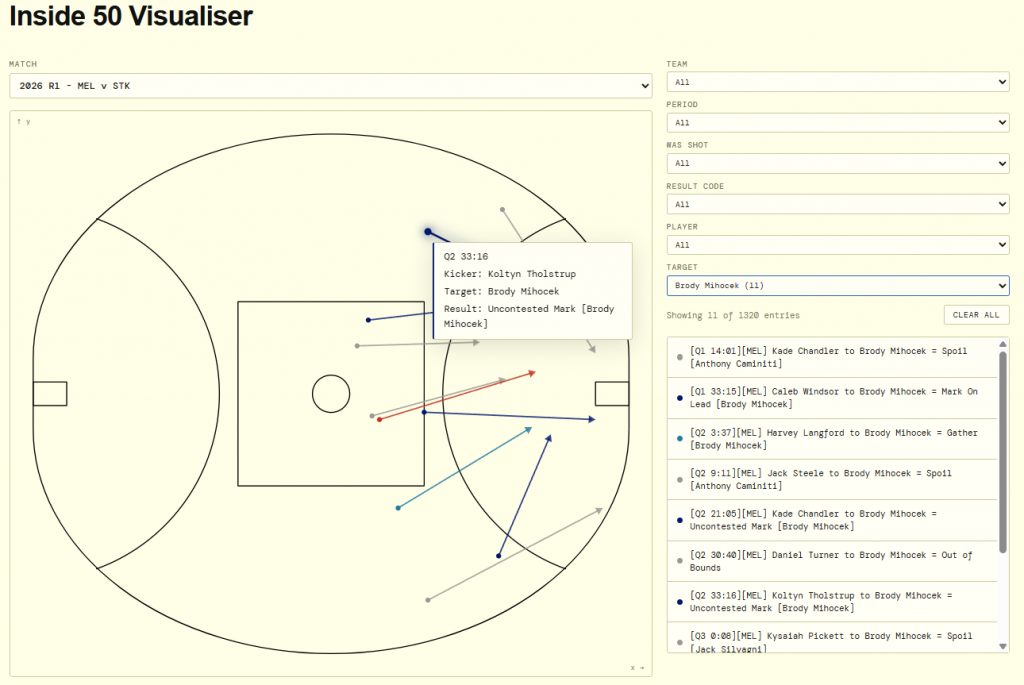
Disclaimer: While the code to interpret the data was written by me using R, I’ve used Claude to assist with building the visualiser in Javascript.
In pulling it together I’ve got a bunch of underlying data on inside 50s so here’s a few early observations.
Tim Membrey has the highest mark or free kick rate of any player targeted in the f50 10+ times, while teammate Jack Buller has not yet registered a mark from 13 targets.
A quick look at the other end with the kickers. Ed Richards clearly on top with his kicks ending in a mark or free kick 47% of the time.
I’ll come back to this as the season develops, but in the meantime if you’ve got feedback on the visualiser the easiest place to contact me is on twitter.
Around the Grounds
Want to submit something? Get in touch!
If you’d like to contribute to This Week in Football feel free to get in touch via email on: ThisWeekInAustralianFootball@gmail.com